
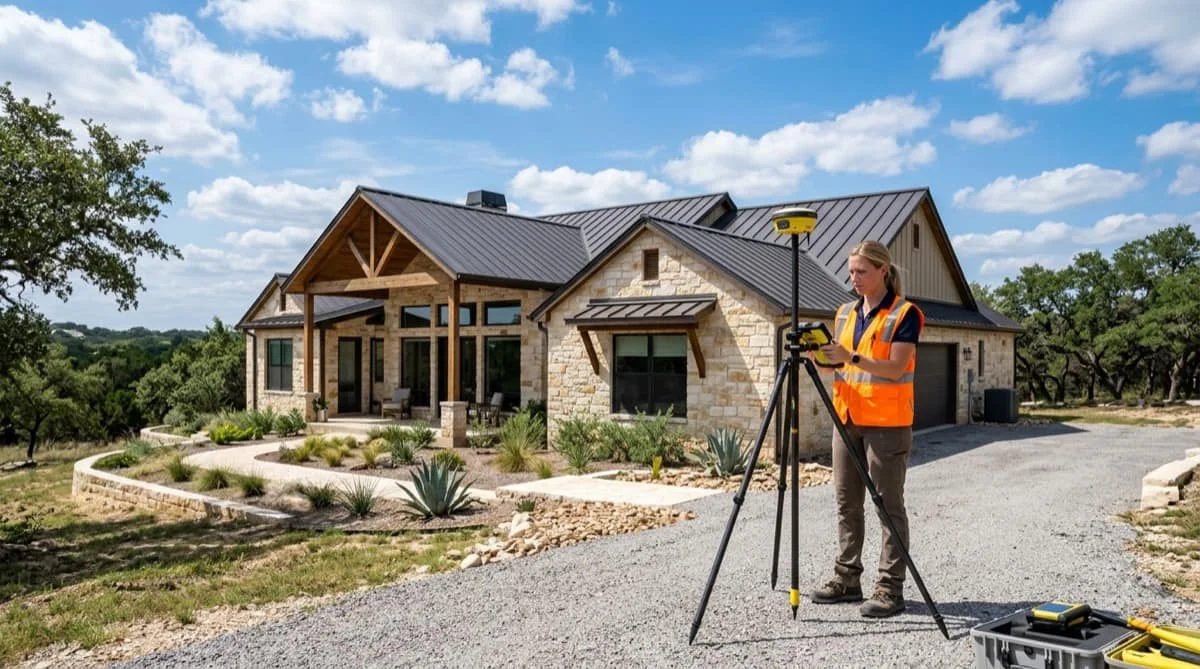
Survey Works provides property surveys for homeowners, home buyers, property sellers, real estate agents, and residential builders across Central Texas.
Most people searching for a "property survey" are trying to answer one of two questions:
- Where exactly are my property lines?
- What currently exists on the property?
In practice, this usually means one of two types of surveys: a boundary survey, which establishes the property lines on the ground, or an as-built survey, which documents existing improvements like buildings, driveways, and fences.
This page explains what's typically included in a property survey and how to determine the right scope for your project.
Property surveys are also referred to as property line surveys, property boundary surveys, land surveys, or boundary surveys. The deliverable is a sealed survey drawing, prepared by a licensed land surveyor, with monuments set on each corner so the property line is visible on the ground.
What a property survey covers
In most cases, this refers to a boundary survey, which focuses on establishing and documenting the property lines. Every property survey reconciles the legal record with the physical conditions on the ground. The surveyor researches the recorded deed, the filed subdivision plat, the chain of title, and the surveys on adjoining properties. In the field, the crew locates existing monuments, iron pins, fence lines, and other evidence of how past owners and surveyors understood the boundary. The final deliverable is a sealed drawing that reconciles both records into a single defensible set of corners, backed by physical markers set on the property.
In some cases, clients are not only concerned with the property lines, but also with documenting what currently exists on the site. When that is the primary need, the scope shifts toward an as-built survey, which focuses on locating buildings, driveways, and other improvements in relation to the property boundaries.
Additional scope like topographic contours, tree location, or utility information can be added to the same deliverable when the project needs it.
When to order a property survey
Most property surveys are ordered around specific life events or projects that depend on a defensible property line:
- Buying a home or a parcel of land, to verify the property being purchased matches the legal description in the deed
- Selling a property where the buyer's lender or title company requires current survey evidence
- Installing a fence along the line with a neighbor
- Resolving a property line or encroachment dispute
- Planning an addition, accessory dwelling unit, pool, or other improvement that has to respect a setback
- Subdividing a parcel or adjusting a lot line
- Documenting the line before an inherited property is transferred
Some of these triggers come with a hard deadline, like a real estate closing, and some do not, like a fence install. Either way, Survey Works schedules the fieldwork and delivers the sealed drawing on a timeline that fits the project's actual need.
Easements and impervious cover on Austin property surveys
Two Austin-specific scopes come up often as part of a property survey. Easements, including utility, access, drainage, and right-of-way, are documented on the sealed drawing, and when an easement survey is specifically needed to resolve a dispute, establish a new easement, or document an existing one before a transaction, we handle that as a focused subset of the broader property survey work. Impervious cover is the other. The City of Austin and Travis County limit how much of a property can be covered by buildings, hardscape, and other non-permeable surfaces. For owners planning an addition, pool, patio, or accessory structure, Survey Works can quantify existing impervious cover on the property as part of the survey deliverable, giving the architect and permit reviewer the numbers the project requires.
Property survey vs. boundary survey
Homeowners, buyers, and real estate professionals usually use the phrase property survey, while surveyors, engineers, and attorneys tend to use boundary survey for the same work. The core scope is the same. A detailed, technical look at boundary work specifically, including the research and monumentation methods that drive the timeline on older Austin neighborhoods, is covered on our boundary surveys page. For commercial real estate transactions that require a more comprehensive deliverable, the equivalent product is an ALTA/NSPS Land Title Survey prepared to the national ALTA/NSPS standard.
Residential and commercial property surveys
Most residential property surveys are straightforward when the site was platted recently and the corners are easy to find. On older lots, in historic Austin neighborhoods, or on rural parcels with irregular boundaries, the work takes longer because the surveyor has to reconcile more historical evidence against the physical conditions on the ground. Survey Works scopes each residential job to the evidence the specific site presents, and prices it accordingly.
Commercial property surveys cover a wider range of use cases, from small commercial parcels to larger developments and multi-tenant sites. Commercial work often pairs with topographic and utility scope on the same deliverable, and on transactions that require the comprehensive ALTA/NSPS standard, the property survey scope is absorbed into the larger ALTA product.
Survey Works has performed property surveys across Central Texas for over 10 years, from newly platted suburban lots to century-old parcels in historic Austin neighborhoods. Every project runs through the same process, calibrated to the evidence the site presents and the use the survey has to support.
For a property survey anywhere in Central Texas, whether for a home purchase, a fence install, a permit application, or a dispute with a neighbor, Survey Works has the field experience and records expertise to deliver a defensible line.